
Buying diamond jewellery is exciting, but it can also feel confusing when you hear terms like cut, colour, clarity, and carat. These four terms are known as the 4Cs of diamonds, and they help define the beauty, quality, and value of a diamond.
Whether you are buying a diamond ring, earrings, pendant, bracelet, or bridal jewellery, understanding the 4Cs can help you make a more confident choice. A diamond is not just about how big it looks. Its sparkle, finish, colour, purity, and overall brilliance all matter.
In this guide, we will explain the 4Cs of diamonds in a simple and practical way so you know exactly what to look for before making a purchase.
What Are the 4Cs of Diamonds?
The 4Cs of diamonds are:
- Cut
- Colour
- Clarity
- Carat
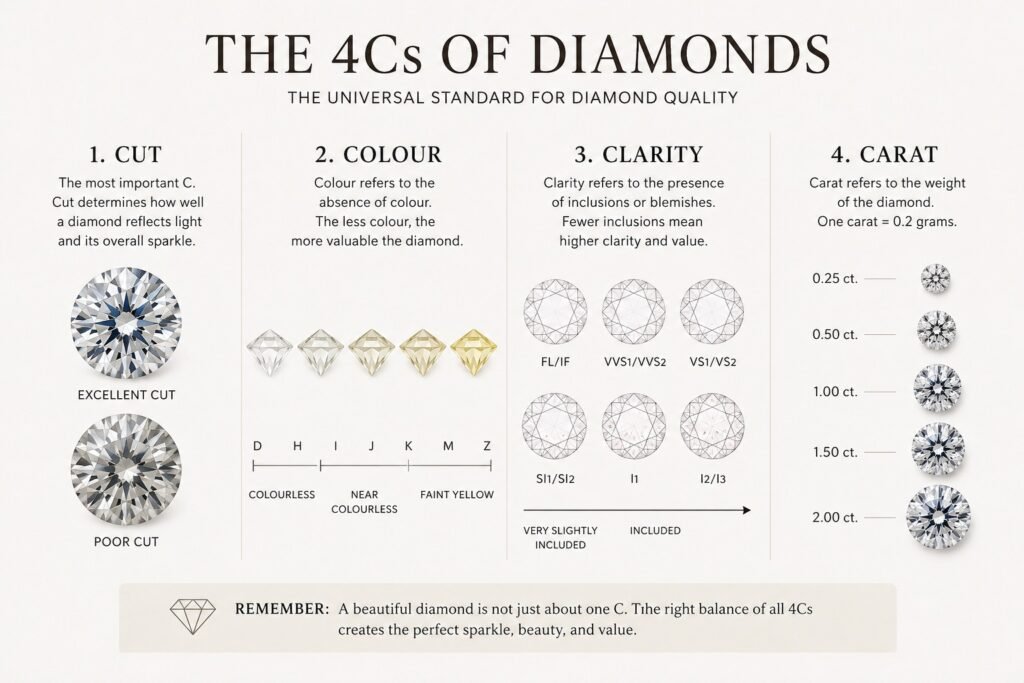
Together, these four factors help determine the quality and price of a diamond. Each C tells you something different about the stone.
- Cut affects how much the diamond sparkles.
- Colour tells you how colourless or tinted the diamond is.
- Clarity refers to the natural marks or inclusions inside the diamond.
- Carat measures the weight of the diamond.
A well-balanced diamond is not always the biggest or the most expensive one. The best diamond is the one that gives you the right balance of beauty, quality, and value.
1. Cut: The Secret Behind Diamond Sparkle
Out of all the 4Cs, cut is one of the most important factors because it directly affects how much a diamond sparkles.
Many people think diamond cut means the shape of the diamond, such as round, oval, pear, emerald, or marquise. But in diamond grading, cut actually refers to how well the diamond has been shaped, proportioned, polished, and faceted.
A beautifully cut diamond reflects light better. This creates brightness, fire, and scintillation — the sparkle you notice when the diamond moves.
Why Diamond Cut Matters
Even if a diamond has excellent colour and clarity, it may look dull if the cut is poor. On the other hand, a well-cut diamond can look lively, bright, and luxurious even if it is smaller in size.
A good cut allows light to enter the diamond, reflect beautifully, and return to the eye. This is what gives a diamond its brilliance.
Diamond Cut Grades
Diamond cut grades usually range from:
- Excellent
- Very Good
- Good
- Fair
- Poor
For maximum sparkle, buyers usually prefer diamonds with an Excellent or Very Good cut grade, especially for engagement rings and solitaire jewellery.
Buyer Tip
If you want your diamond to look bright and eye-catching, never compromise too much on cut. A smaller diamond with a better cut can look more beautiful than a larger diamond with a poor cut.
2. Colour: How Colourless Is Your Diamond?
Diamond colour refers to how white or colourless a diamond appears.
In most white diamonds, the less colour present, the more valuable the diamond is. The highest-quality white diamonds appear colourless, while lower grades may show a slight yellow or brown tint.
Diamond Colour Scale
Diamond colour is usually graded from D to Z.
- D, E, F: Colourless
- G, H, I, J: Near colourless
- K to M: Faint colour
- N to Z: Noticeable colour
A D colour diamond is considered the most colourless and rare. However, near-colourless diamonds such as G, H, or I can also look beautiful, especially when set in jewellery.
Does Diamond Colour Really Matter?
Yes, but it depends on the jewellery design and metal colour.
For example, if you are choosing a white gold or platinum setting, a higher colour grade may be more noticeable. But if the diamond is set in yellow gold or rose gold, a slight warmth in the diamond may blend beautifully with the metal.
Buyer Tip
You do not always need the highest colour grade to get a beautiful diamond. A near-colourless diamond can offer excellent beauty and better value, especially for everyday jewellery.
3. Clarity: Understanding Natural Inclusions
Diamond clarity refers to the presence of internal or external characteristics in a diamond. Internal marks are called inclusions, and external marks are called blemishes.
Since diamonds are formed under intense pressure and heat, it is natural for them to have tiny marks. Most of these are not visible to the naked eye and can only be seen under magnification.
Diamond Clarity Scale
Diamond clarity is usually graded as:
- FL: Flawless
- IF: Internally Flawless
- VVS1 and VVS2: Very, Very Slightly Included
- VS1 and VS2: Very Slightly Included
- SI1 and SI2: Slightly Included
- I1, I2, I3: Included
Flawless diamonds are very rare and expensive. But for most buyers, diamonds in the VS or SI range can look clean and beautiful when viewed normally.
Eye-Clean Diamonds
An “eye-clean” diamond means the inclusions are not visible to the naked eye. This can be a smart choice because you get a beautiful-looking diamond without necessarily paying for the highest clarity grade.
Buyer Tip
Do not focus only on getting a flawless diamond. Instead, look for a diamond that appears clean and bright when worn. In many cases, a VS or good SI clarity diamond can be a practical and beautiful choice.
4. Carat: The Weight of a Diamond
Carat refers to the weight of a diamond, not its size. One carat equals 0.2 grams.
Many buyers think carat is the most important factor because it affects how large the diamond looks. While carat does influence size and price, it should not be considered alone.
A larger diamond with poor cut, low colour, or visible inclusions may not look as beautiful as a smaller diamond with better overall quality.
Carat vs Size
Two diamonds with the same carat weight can look different in size depending on their shape and cut. For example, oval, pear, and marquise diamonds may appear larger than round diamonds of the same carat weight because of their elongated shape.
Carat and Price
Diamond price increases with carat weight, but not always in a simple way. Larger diamonds are rarer, so the price can rise significantly as carat weight increases.
This is why a 1-carat diamond may cost much more than two 0.50-carat diamonds of similar quality.
Buyer Tip
Instead of focusing only on carat, choose a diamond that has a good balance of cut, colour, clarity, and carat. A well-balanced diamond will always look more elegant.
Which of the 4Cs Is Most Important?
All 4Cs are important, but cut usually has the biggest impact on beauty and sparkle.
Here is a simple way to prioritise:
- Cut for sparkle
- Colour for whiteness
- Clarity for purity
- Carat for size
If you want a diamond that looks brilliant and luxurious, start with cut. Then balance the other Cs based on your budget and preference.
How the 4Cs Affect Diamond Price
The 4Cs directly influence diamond pricing. A diamond with high grades in all four categories will usually be more expensive.
For example, a diamond with excellent cut, D colour, flawless clarity, and high carat weight will be rare and premium. But not every buyer needs the highest grade in every category.
A smart diamond purchase is about choosing the best combination for your purpose.
For daily wear, you may prefer a practical balance. For an engagement ring or bridal jewellery, you may want a higher grade diamond with more brilliance and long-term value.
Best 4Cs Combination for Diamond Jewellery
For Engagement Rings
Choose a diamond with excellent or very good cut, near-colourless colour, eye-clean clarity, and a carat size that suits your budget.
For Diamond Earrings
You can be slightly flexible with clarity and colour because earrings are usually viewed from a distance. Focus on sparkle and matching stones.
For Diamond Pendants
Cut and shape matter a lot because pendants sit at the centre and catch light beautifully. Choose a bright, well-cut diamond.
For Diamond Bracelets
Since bracelets use multiple stones, consistency in colour, clarity, and sparkle is important. The diamonds should look balanced together.
For Bridal Jewellery
For bridal diamond jewellery, the overall look matters. Choose diamonds that offer sparkle, elegance, and harmony with the design.
Certified Diamonds: Why Certification Matters
When buying diamond jewellery, always ask for certification or a grading report.
A diamond certificate gives you details about the diamond’s cut, colour, clarity, carat weight, measurements, and other important features. It helps you know exactly what you are buying.
Certification also builds trust and transparency between the jeweller and the customer.
Final Thoughts
The 4Cs of diamonds — Cut, Colour, Clarity, and Carat — are the foundation of diamond buying. Once you understand them, choosing the right diamond becomes much easier.
A beautiful diamond is not just about size. It is about how well it sparkles, how clean it looks, how balanced its colour is, and how beautifully it fits into the jewellery design.
Before buying diamond jewellery, take time to understand the 4Cs, ask questions, and choose a trusted jeweller who guides you honestly.
At the end of the day, the perfect diamond is the one that feels right for your story, your style, and your special moment.
FAQs
1. What are the 4Cs of diamonds?
The 4Cs of diamonds are Cut, Colour, Clarity, and Carat. These four factors help determine a diamond’s quality, beauty, and value.
2. Which C is most important in a diamond?
Cut is usually considered the most important because it affects the diamond’s sparkle and brilliance.
3. Does carat mean diamond size?
Carat measures the weight of a diamond, not the exact size. However, higher carat weight usually means a larger-looking diamond.
4. What is a good diamond colour grade?
D, E, and F are colourless grades, while G, H, I, and J are near colourless and can also look beautiful in jewellery.
5. What clarity grade is good for diamond jewellery?
VS and SI clarity diamonds are often preferred because they can look clean to the naked eye while offering good value.
6. Should I buy only certified diamonds?
Yes, buying certified diamonds is always recommended because certification gives you clear details about the diamond’s quality.
7. What matters more: diamond size or sparkle?
Sparkle usually matters more than size. A smaller well-cut diamond can look more beautiful than a larger poorly cut diamond.